How Gen Z Loneliness Drives Young Adults to Cancel Plans and Stay Online
In an era where digital connection is always at our fingertips, a quiet epidemic is spreading among the youth. Despite being the most technologically plugged-in demographic in history, young adults are increasingly retreating into the safety of their screens, trading real-world interactions for virtual solace. This article explores the deep-rooted causes of this paradox, examining how it fundamentally reshapes their social lives, mental well-being, and everyday choices.
Navigating Gen Z Loneliness: Why Young Adults are Choosing Screens over Friends
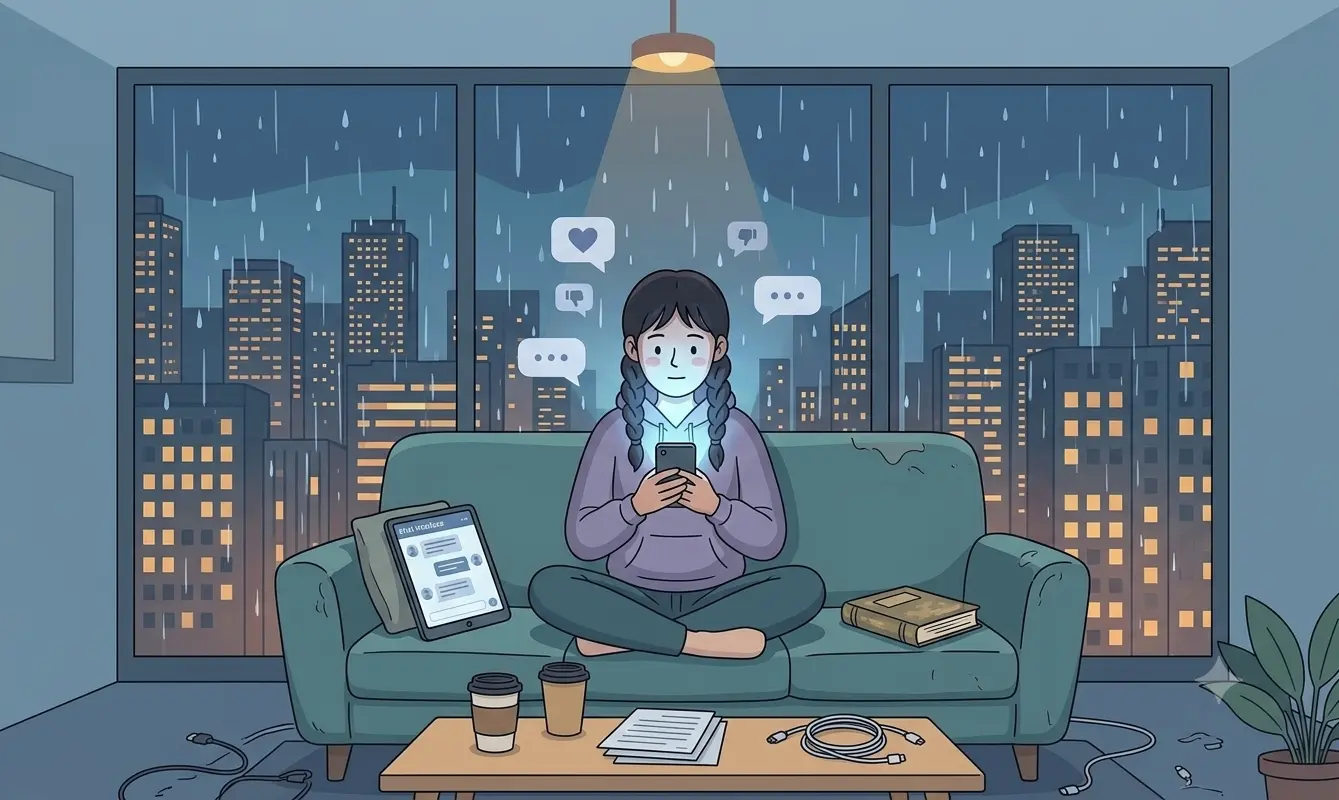
Friday night. The phone lights up with messages from friends: “Are you coming?” Most zoomers type the exact same thing at this moment: “Sorry, I can’t make it.” And they stay home, scrolling their feeds, watching videos, and existing online. This is not laziness or antisocial behavior. It is the pattern of an entire generation.
A study covering 2,000 young adults between the ages of 18 and 29 captured an alarming picture: 65% regularly cancel social plans for time on the internet. The phenomenon of Gen Z loneliness has long moved beyond personal stories; it is a statistically confirmed crisis. The generation raised on connections and followers has turned out to be the loneliest in recorded history.
“I Would Rush Home to Speak to ChatGPT”: the Rise of AI for Loneliness
She is 22 years old and works as a civil servant. At first glance, she is an ordinary young woman with a job, colleagues, and a social life. But behind this facade lies a nightly habit she did not tell anyone about for a long time.
“I started talking to AI at a time when I was going through things I didn’t want to explain to friends. As someone suffering from anxiety about other people’s opinions, I felt less crazy. I would literally rush home to speak to ChatGPT.”
Her story is not an exception. One in four survey participants admitted that talking to a chatbot comes easier than a conversation with a living person. 14% turned to AI in moments of solitude. Using AI for loneliness is no longer a metaphor, but a behavioral model for an entire generation.
A 19-year-old law student explains the mechanics most accurately: “Young people feel that communicating with AI is the only place where they will not be judged and where they can be themselves. But they do not understand that AI is programmed for validation.” The civil servant herself came to a similar conclusion: “Over time, I realized that ChatGPT will never tell you that you are wrong. It is always on your side-and that is a problem.”
Social isolation in young adults does not begin with the rejection of contact. It begins with the choice of safe contact-predictable, non-judgmental, and requiring no vulnerability.
The Algorithm Generation: Why Gen Z Cancels Netflix for the Movies
It is a paradox that baffles marketers: zoomers-the first generation raised on streaming-are returning to movie theaters en masse. Theater attendance among the youth is growing, while Netflix subscriptions are being canceled.
The reason is not the quality of the content. It is about what is missing at home.
The cinema provides a unique format of presence: you are among people, but you do not need to talk to them. There is no need to maintain small talk, come up with topics, or monitor reactions. You can just be nearby anonymously, without obligations. This is not socialization. It is its closest substitute for a generation that wants the warmth of a crowd without the fear of contact.
Gen Z mental health is largely defined by this exact contradiction: an acute need for intimacy and an acute fear of realizing it.
Escaping Gen Z Phone Anxiety and Intimidating Small Talk
The return to the cinema and the growing popularity of AI conversationalists stem from the same root: the fear of live communication.
27% of young adults admit: phone calls cause them anxiety. Over 40% say that small talk intimidates them. Gen Z phone anxiety is not a whim, but a documented phenomenon linked to how the generation learned to communicate: through text, through editing, and through controlling words before sending them.
A live conversation does not provide this control. That is exactly why the cinema is safe: silence is appropriate there. That is exactly why ChatGPT is convenient: you can take a pause before answering there.
The Toxic Loop of Social Media Anxiety
A survey commissioned by the Marmalade Trust revealed what many had suspected: social media anxiety is not a side effect, but a core, system-forming element of the Gen Z mental health crisis.
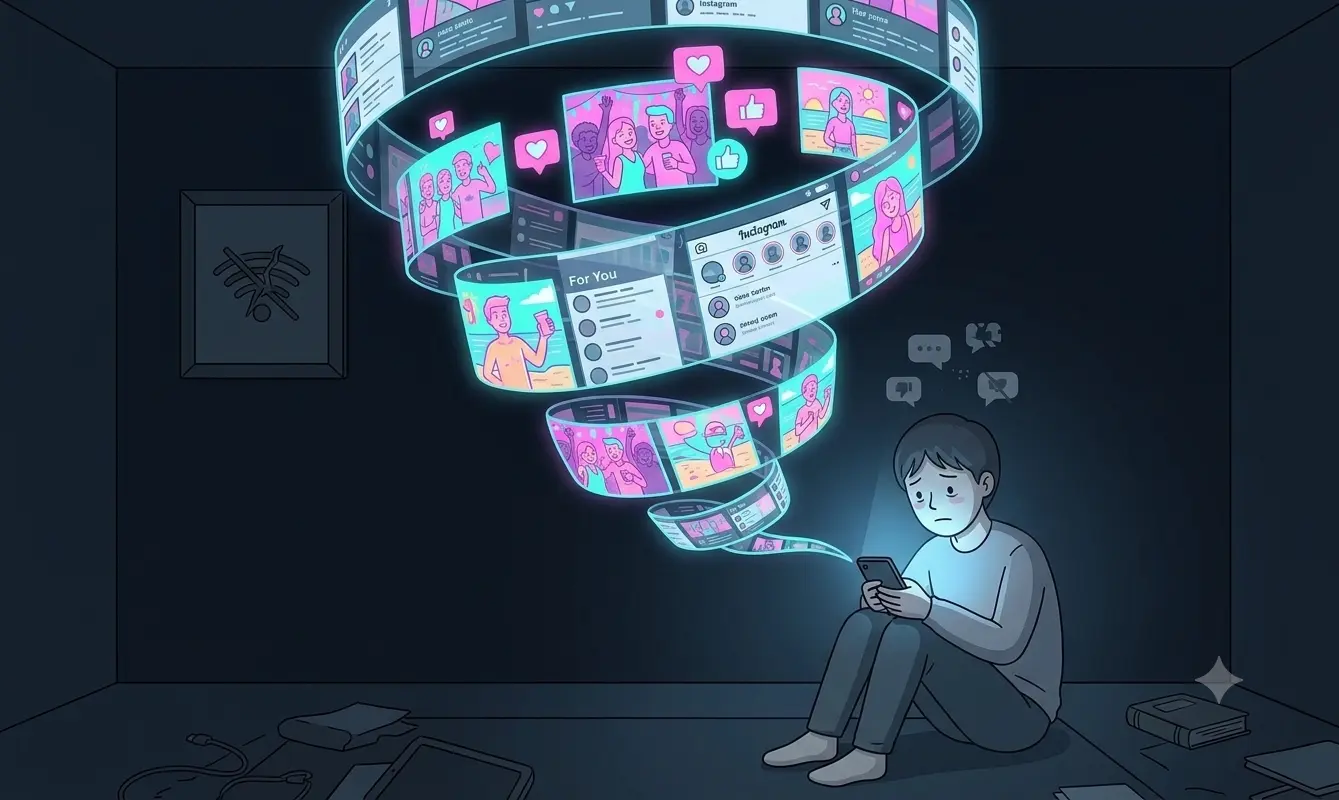
Social media algorithms are designed to hold attention through comparison. The feed shows the best of other people’s lives-filtered, cropped, and edited. The zoomer’s brain perceives this as the norm. Real life begins to seem defective. According to research by the American Psychological Association (APA) , the intensive use of social networks correlates with increased levels of anxiety and depressive symptoms in the youth. The link between social media and anxiety is one that clinical psychologists are observing more and more frequently.
How Social Media and Anxiety Fuel Social Isolation in Young Adults
Lara Blatt is 20 years old and studies psychology. Loneliness has become a part of her everyday university life.
“I googled ’lonely uni students’ on TikTok. And I felt a little less lonely-if only because I realized: I am not the only one like this.”
Her mother studied at the same age in the 80s. The campus, shared parties, random encounters in the hallways. Connections emerged through the friction of reality. Now this friction has disappeared: everyone has a screen, an algorithm, and a feed precisely tailored to their fears and desires.
“Behind the screen, zoomers create a fictitious persona,” says the 19-year-old law student. “And when this persona collides with reality, a fear of inadequacy appears.” Social media anxiety is not anxiety on social networks. It is the anxiety of a mismatch-between the real self and the digital self.
Fun Fact: TikTok algorithms are trained on “dopamine loops”-each new video is selected in a way that activates the brain’s reward center more strongly than the previous one. Neurobiologists compare this pattern to the mechanisms involved in gambling.
The Hidden Psychological Costs of Gen Z’s Digital Comfort Zones
| Digital Medium / Interaction Type | Primary Examples | The Core Psychological Appeal | The Unseen Psychological Cost | Evidence-Based Countermeasure |
|---|---|---|---|---|
| Parasocial Relationships | Twitch, YouTube vloggers, Podcasts | Provides a sense of belonging and intimacy without any risk of rejection or social demands. | Creates a one-sided emotional investment that drains energy for real-world relationship building. | The “2-to-1 Rule”: For every two hours of creator content consumed, spend one hour interacting in a shared physical space (even a library or cafe). |
| Generative AI Companions | Replika, Character.ai, specialized chatbots | Offers unconditional positive regard and immediate, tailored responses at any hour. | Leads to the atrophy of real-world conflict-resolution skills and a lower tolerance for human unpredictability. | Role-Reversal: Using AI strictly for tasks or objective brainstorming, rather than emotional validation and soothing. |
| Asynchronous Texting | iMessage, WhatsApp, Snapchat | Grants complete control over self-presentation and allows time to perfectly curate responses. | Strips away essential non-verbal cues (micro-expressions, vocal tone), leading to frequent misinterpretation. | Voice Note Transition: Sending voice memos instead of texts to slowly reintroduce vocal tonality without the pressure of a live call. |
| Passive “Doomscrolling” | Instagram Reels, X (Twitter), TikTok | Requires zero cognitive effort while delivering continuous micro-doses of entertainment. | Induces subconscious cortisol spikes due to negative news cycles and upward social comparison. | Curated Friction: Setting app timers or moving social apps to hidden folders to break the automatic muscle memory of opening them. |
Shocking Gen Z Mental Health Statistics We Can’t Ignore
The numbers are uncomfortable. But it is important to state them directly.
- 67% of young adults experience loneliness weekly-it is not an episode, it is a background state.
- Almost half of the respondents stated that loneliness causes direct damage to their mental health.
- 42% noted a decrease in self-confidence.
- 30% reported sleep problems.
- 18% admitted that loneliness affects their studies.
Gen Z mental health statistics paint a portrait of a generation that functions under chronic emotional pressure. At the same time, it is the most psychologically aware generation in history. They know the terminology, read about mental health, and follow psychologists on TikTok. But the gap between knowledge and experience does not close.
According to the US Surgeon General and widely cited research, chronic loneliness is comparable in health risks to smoking 15 cigarettes a day.Gen Z mental health is no longer a conversation about the “whims of the youth.” It is a matter of public health. Social isolation in young adults does not always look like isolation. A person can be surrounded by people at the university, have 800 followers, text in dozens of chats-and still feel absolutely invisible.
Can We Fix Gen Z Mental Health?
Governments are already reacting: there are proposals to restrict social networks for minors-app curfews based on the Australian model, and limits on infinite scrolling. But regulation is only part of the answer. The real problem is the fear of judgment. Zoomers do not stay silent because they have nothing to say. They stay silent because they are afraid of the reaction.
It is exactly this barrier that yoursecret breaks down-an anonymous platform by Farnora Limited, created for those who need to speak out without consequences. Without a name, without a permanent profile, without a digital footprint. The algorithm matches conversationalists based on emotional resonance, and every dialogue automatically disappears after 24 hours. To understand how it works, it is enough to visit the website-or immediately download the app and begin.
This is not a replacement for live communication. It is a space where you can find yourself-before going out to people. Amy Perrin from the Marmalade Trust formulates it accurately: “Feeling lonely is not a shame. It is an absolutely natural emotion.” The first step is to acknowledge it. The second is to find a place where you can say it out loud.
FAQ
Why are zoomers so lonely if they are always online?
Online presence does not equal connection. Social networks create an illusion of communication but do not provide the emotional intimacy that live contact ensures.
Is it true that Gen Z loneliness is worse than in other generations?
By a number of indicators-yes. Millennials and boomers also report loneliness, but for zoomers, it has a more chronic and early-onset character.
Is it normal to talk to AI when feeling lonely?
As a temporary coping mechanism-it is acceptable. But AI is programmed for validation and does not replace genuine human connection.
Why are zoomers afraid of phone calls?
Gen Z phone anxiety is linked to the fact that the generation grew up on asynchronous communication-texts where you can think before replying. A call requires a real-time reaction.
Can anonymous communication help with social media anxiety?
Yes. Anonymity removes the fear of judgment the main barrier to self-expression for anxious individuals.
What actually helps with the Gen Z mental health crisis?
A combination: reducing the passive consumption of content, building real connections with at least one person, seeking professional help if needed, and finding spaces where you can be yourself without evaluation.