How to Deal with Social Anxiety - Without Lectures and Without Nerves
Long story short. You came to a party. You kind of wanted it yourself. And here you are, standing by the wall with a glass you finished a long time ago, thinking about only one thing - how to dissolve. Literally. Become part of the wallpaper. This is not weakness - this is social anxiety, and it is real.
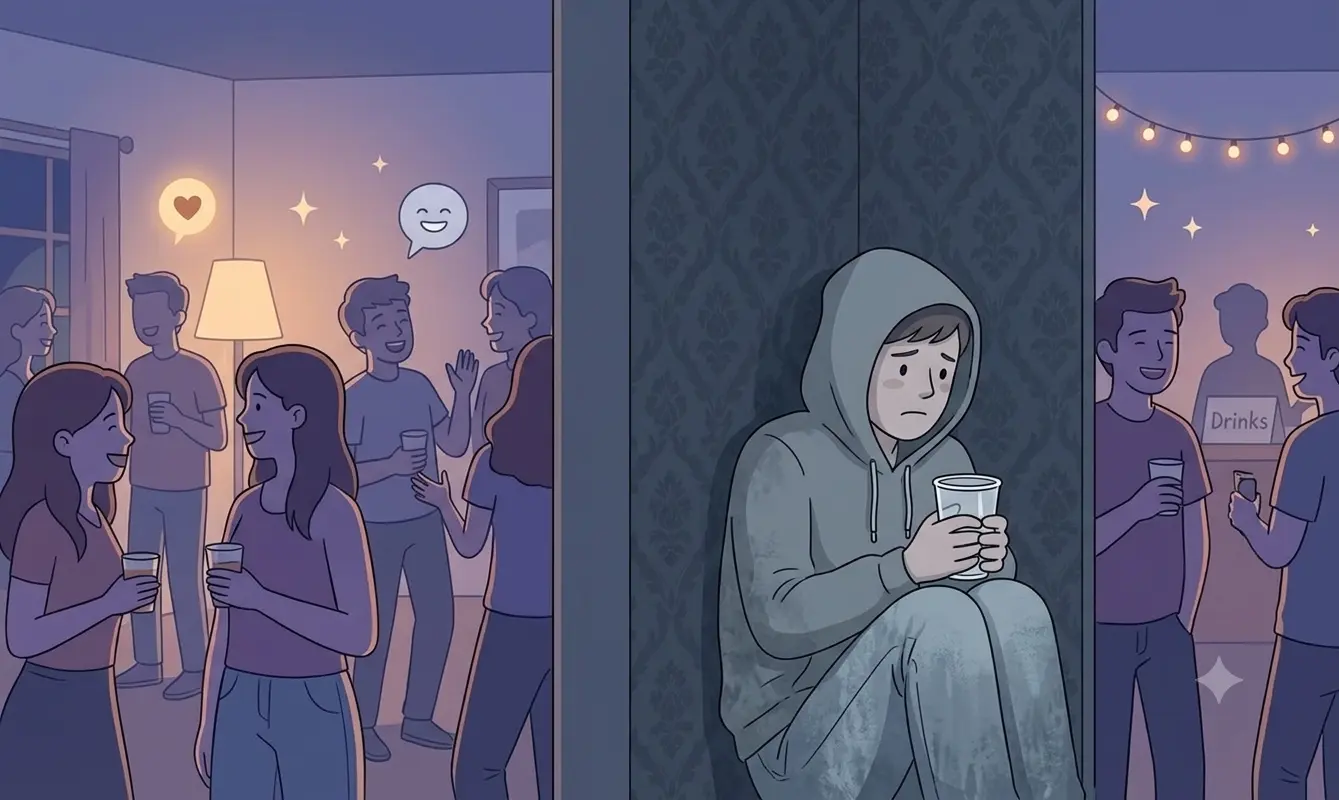
Do you know this feeling when the brain starts planning an escape route even before you have time to take off your jacket? That is exactly it. And it would be fine if it happened just once. But it happens every single time - at work, in class, in the store, in the elevator with a neighbor. There is this background noise everywhere: “they are looking, they are evaluating, they see that something is wrong with me.” And you retreat into your head - to analyze, to anticipate, to be preemptively ashamed of what you have not even said yet.
What Exactly is Social Phobia - and Why it is Not “Just Character”
Social phobia is when the fear of social situations becomes so strong that it actually starts to interfere with life. It is not just “I do not like crowds.” It is - I avoid job interviews. I cannot make a phone call to an unfamiliar place. I postpone going to the doctor because I will have to talk to the receptionist there, and what if I say the wrong thing. Sounds familiar?
In such situations, the brain literally goes into threat mode. Cortisol, adrenaline - all of that. The body thinks you are not going to a presentation, but straight to a tiger. Physically - it is the same. By the way, the guys from the APA confirmed: social anxiety disorder is one of the most common anxiety disorders, affecting about 7% of the population annually. So you are definitely not the only one like this in the room. Statistically - for sure.
And no - this is not introversion. An introvert simply recharges in solitude but is not afraid of people. But social phobia is when communication causes genuine fear, a rapid pulse, and a desire to urgently invent a reason to leave.
How to Overcome Social Anxiety in 3 Low-Stress Steps
Let’s get down to business. Here is what really works - without “just be yourself” and without motivational quotes on a pink background.
1. Stop Fighting Symptoms - Start Noticing Them
You blush. Your voice trembles. And the first reaction is panic about the panic. A vicious circle that only spins faster. Try something else: just name what is happening. Not out loud (although you can do that too). Inside - “okay, my anxiety response has activated right now. It is unpleasant. It will pass.” It sounds trivial - but these are real tips for social anxiety that work. The technique is called “the observer,” and it knocks the brain out of the catastrophizing loop. You stop fighting - and the anxiety loses half of its power.
2. Small Steps, Not Heroic Leaps
How to overcome social anxiety fast is a question I want to ask right now. A pill. Or a technique. Three breaths - and you are a lion. But no. Gradual exposure works - when you face what scares you in metered doses. First, write to a stranger in a chat. Then ask a salesperson a question. Then go to an event and just be there for 20 minutes - do not make acquaintances, just be. Every step retrains the brain: “see? we did not die. we can.” And this accumulates slowly, but for a long time.
3. Stop Rehearsing Conversations
Seriously. This endless “what if they ask this, and I say that, and they think this” - it devours you even before you leave the house. How to stop social anxiety in the moment - is about returning to the body. Physically. Touch something textured. Name 5 things you see. This is grounding - it genuinely switches the nervous system from “anxiety loops” to “here and now.” It does not work the first time - but it works.
4. About “What They Will Think”
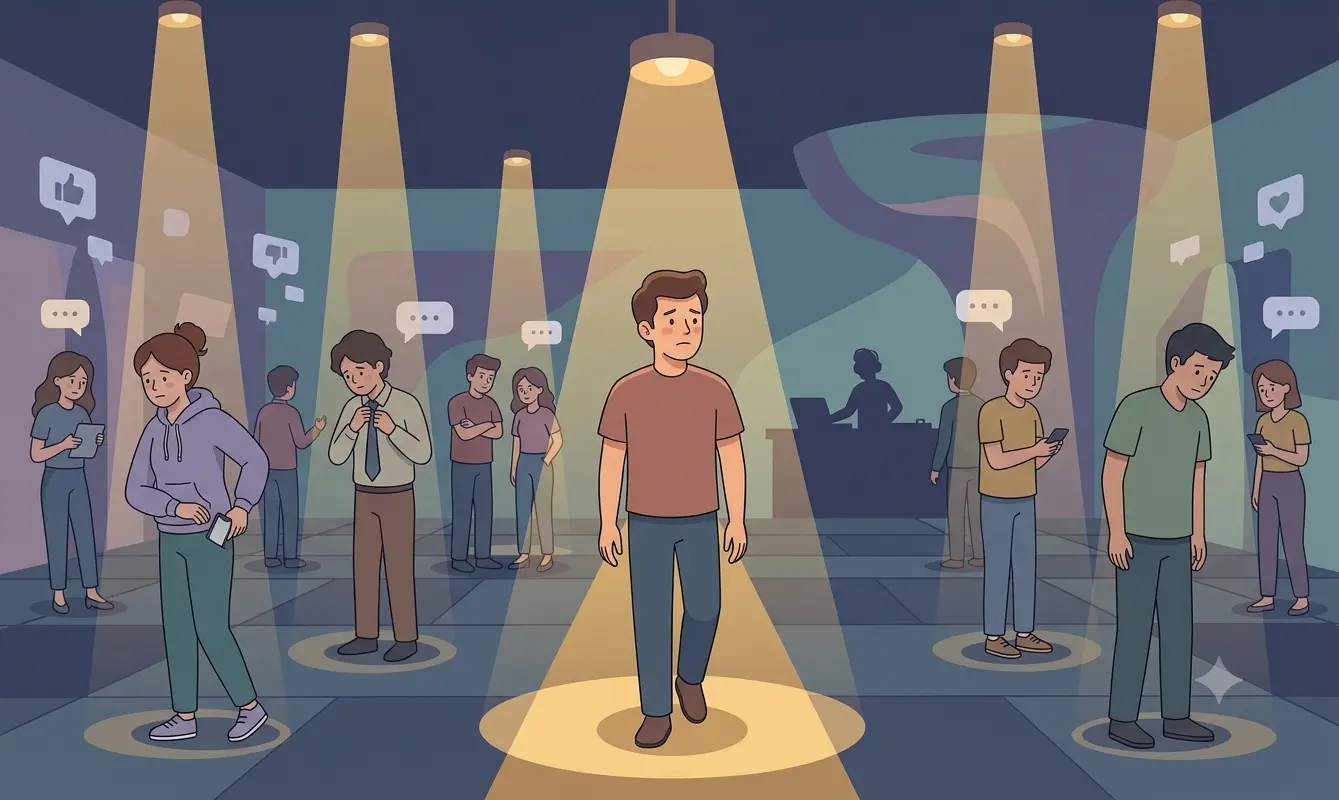
People think about you much less than you think. This is not a consolation - this is a fact. It is called the spotlight effect. We are all so busy with how we look ourselves that we simply physically do not have time to analyze other people’s stumbles and blushing ears. You are not in the center of the stage. You are one of many standing there and thinking: “if only no one notices.” Hug yourself - you are both just trying to survive at this party.
5. Do Not Avoid - but Also Do Not Force Yourself
Avoidance is the main trap of anxiety. The more you avoid, the scarier it seems the next time. But a “kick in the butt” in the style of “go out there and meet people, come on!” - also does not work. The stress of forcing yourself only reinforces the connection “communication = pain”. How to reduce social anxiety - is about balance. Metered discomfort, not torture. A small challenge is not a test of courage, just a step.
Try Anonymous Chatting to Reduce Social Anxiety Fast
Okay, here is an idea. What if you could practice without stakes? Without risk. Without having to meet this person in the elevator or in class later and die of cringe. The YourSecret app by Farnora Limited is a social skills simulator with zero cringe. No photos. No names. Total anonymity - and this is not a bug, it is a feature. The algorithm matches conversational partners by mood - algorithmic sentiment matching - meaning you end up with someone who is on a similar wavelength right now. Messages disappear after 24 hours, so there is no fear of “what if they find and read it later.” Privacy-first - and it shows.
How to get over social anxiety through practice - is exactly about formats like this. You communicate. You learn to formulate your thoughts. You get used to the fact that a conversation is normal and not dangerous. And all this without consequences. For those for whom how to get rid of social anxiety is not just a Google query, but a real everyday task, you can download app to start practicing right away.
If you want to understand which format suits you specifically - here is a brief overview of the methods that have actually been studied:
| Method | How It Works | Time to Effect | Best For | Evidence Level |
|---|---|---|---|---|
| CBT (cognitive behavioural therapy) | Identifies and rewires distorted thinking patterns around social evaluation | 8–16 weeks | Moderate to severe social phobia with avoidance | High - RCT proven |
| Exposure therapy | Gradual, structured contact with feared situations until anxiety habituates | 4–12 weeks | Specific triggers (public speaking, eye contact, crowds) | High - RCT proven |
| SSRIs / SNRIs | Raises serotonin baseline, reduces physiological threat response | 4–6 weeks | Severe anxiety with physical symptoms (trembling, sweating) | High - FDA approved |
| Mindfulness-based therapy (MBSR) | Trains non-reactive observation of anxious thoughts and body sensations | 8 weeks | People with rumination and social perfectionism | Moderate - growing body |
| Acceptance & Commitment (ACT) | Decouples self-worth from social performance; builds values-driven action | 6–12 weeks | High self-criticism, identity tied to others’ approval | Moderate - growing body |
| Social skills training (SST) | Direct practice of conversation, eye contact, turn-taking in safe settings | 6–10 weeks | People with limited social experience, not just fear | Moderate - combined use |
| Beta-blockers (situational) | Blocks adrenaline receptors; eliminates visible physical symptoms | 30–60 min | One-off events: presentations, interviews, performances | Moderate - off-label use |
| Anonymous digital practice | Low-stakes text interaction builds conversational confidence without social risk | Ongoing | Early-stage anxiety, avoidance of any real-world contact | Emerging - limited trials |
When to Ask for Extra Help
There is a moment when self-help is not enough. And that is normal - it is not a weakness, not a failure, not “I did not try hard enough.”
If anxiety has started to actually control your life - you turn down a job you wanted, avoid people who are important to you, cannot go out for bread without a racing heart - this is a signal. Cognitive behavioral therapy for social anxiety works very well, it is not an opinion, it is data.
Fun Fact
The spotlight effect is a cognitive distortion where we overestimate how much others notice our blunders. A Cornell University study: people think others notice their awkwardness twice as often as it actually happens. Half of your “everyone noticed” anxiety is statistically based on nothing. This does not mean the anxiety is not real. It means it makes mistakes - and does so regularly.
FAQ
Is it curable?
Yes. CBT, exposure, sometimes medication. Most people report significant improvement with the right self-work. The main thing is to start.
Is social anxiety the same as introversion?
No. An introvert gets tired of communicating, but is not afraid of it. Social anxiety is fear and avoidance due to the fear of evaluation. Different mechanisms, different experiences.
How to overcome social anxiety if therapy is unavailable?
Self-help books on CBT, anonymous communication formats, gradual exposure. Slowly, but it genuinely works.
Can you cure yourself?
In mild cases - yes. If anxiety is not destroying your life, regular conscious self-work yields tangible results.
Why do I blush and cannot stop it?
Blushing is an automatic response of the nervous system, not subject to direct control. But it decreases along with the general level of anxiety over time.
Is YourSecret safe?
Total anonymity, no names or photos, messages disappear after 24 hours. Data is not stored longer than necessary for the algorithm to work.