How to Make Friends in College If You Are Shy and Anxious
The first semester is a fever dream. You’re in the dining hall, thumbing through a dead screen to look “busy” while spying on the loud tables. They look like they’ve shared secrets since kindergarten. You’re stuck wondering: “Where’s my invite?” It’s as if a social survival guide was handed out at orientation, and you were in the bathroom when it happened.
Drop the guilt. You aren’t a broken machine. Data from the American College Health Association shows 60% of freshmen are essentially in the same boat, drowning in quiet isolation. That knot in your chest? It’s not a defect; it’s a crowded room. Even the girl laughing at the center table is likely faking a sense of belonging.
Stop trying to “manifest” a personality transplant. This isn’t about becoming a loud-mouthed extrovert. It’s about tactical moves for the socially exhausted.
To learn how to strike up a conversation with a stranger without the cringe, you just need to exploit the chaos around you. Forget the “just be yourself” cliché; we’re looking for genuine links that don’t drain your battery.
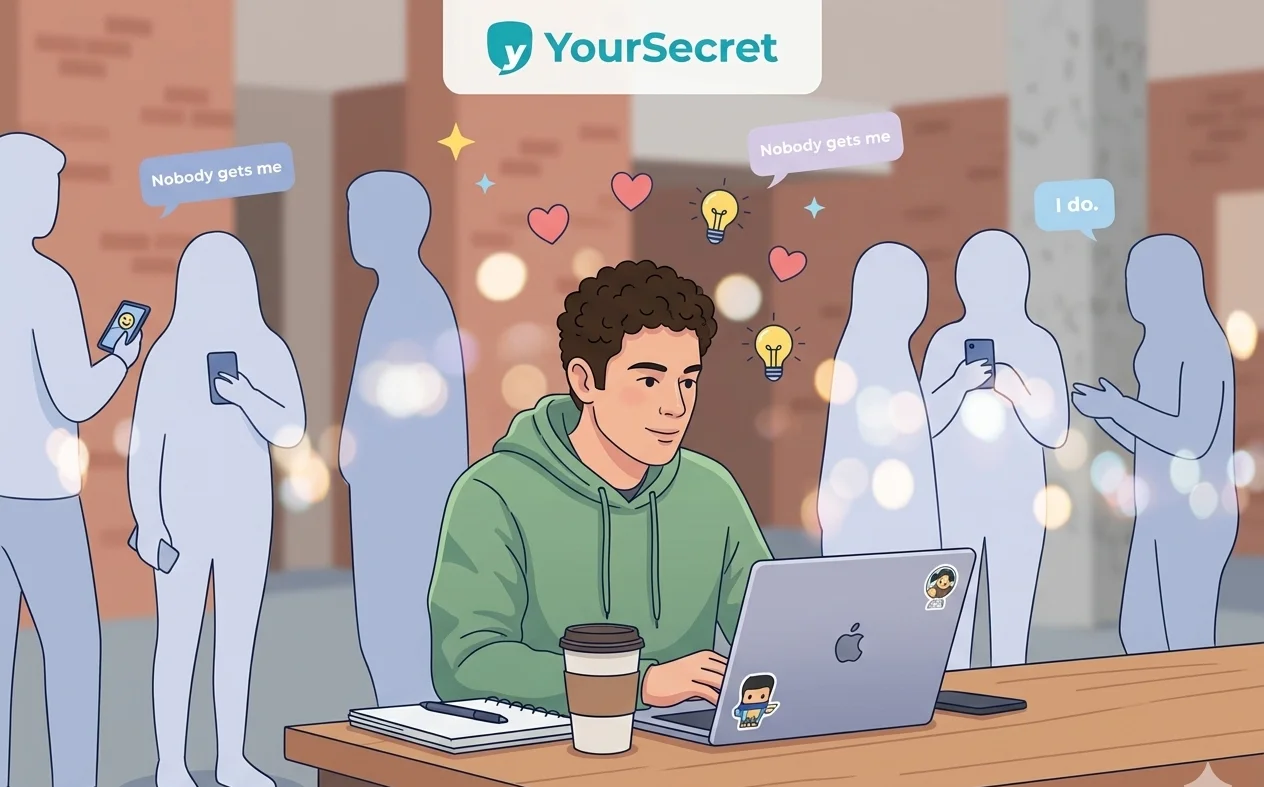
Why Making Friends in College Feels Harder Than It Looks
The problem is not you. Seriously.
The brain of a person with social anxiety focuses on potential threats and overestimates negative signals. This is the spotlight effect - a cognitive bias where it seems that everyone around you is noticing your mistakes. In reality, those around you are preoccupied with their own worries.
High school routines are dead. Now it’s just a massive campus, shifting crowds, and the sudden, brutal need to engineer your own social life. It’s sensory overload. Social anxiety in college feels like being the only actor on stage who didn’t get the script.
Instagram makes it worse. You’re scrolling through a curated loop of house parties and sun-drenched group shots, gaslighting yourself into thinking that is the only version of a “normal” life. It’s a total lie. You’re comparing your messy internal panic to someone else’s polished, filtered exterior. That pressure to perform a “perfect” friendship on day one is exactly what traps people in their dorm rooms. Real connection isn’t a 24/7 party; it’s a slow burn that only starts when you stop chasing the fake standards on your screen.
5 Actionable Steps to Build Connections With Social Anxiety
1. Start Small and Connect Online First
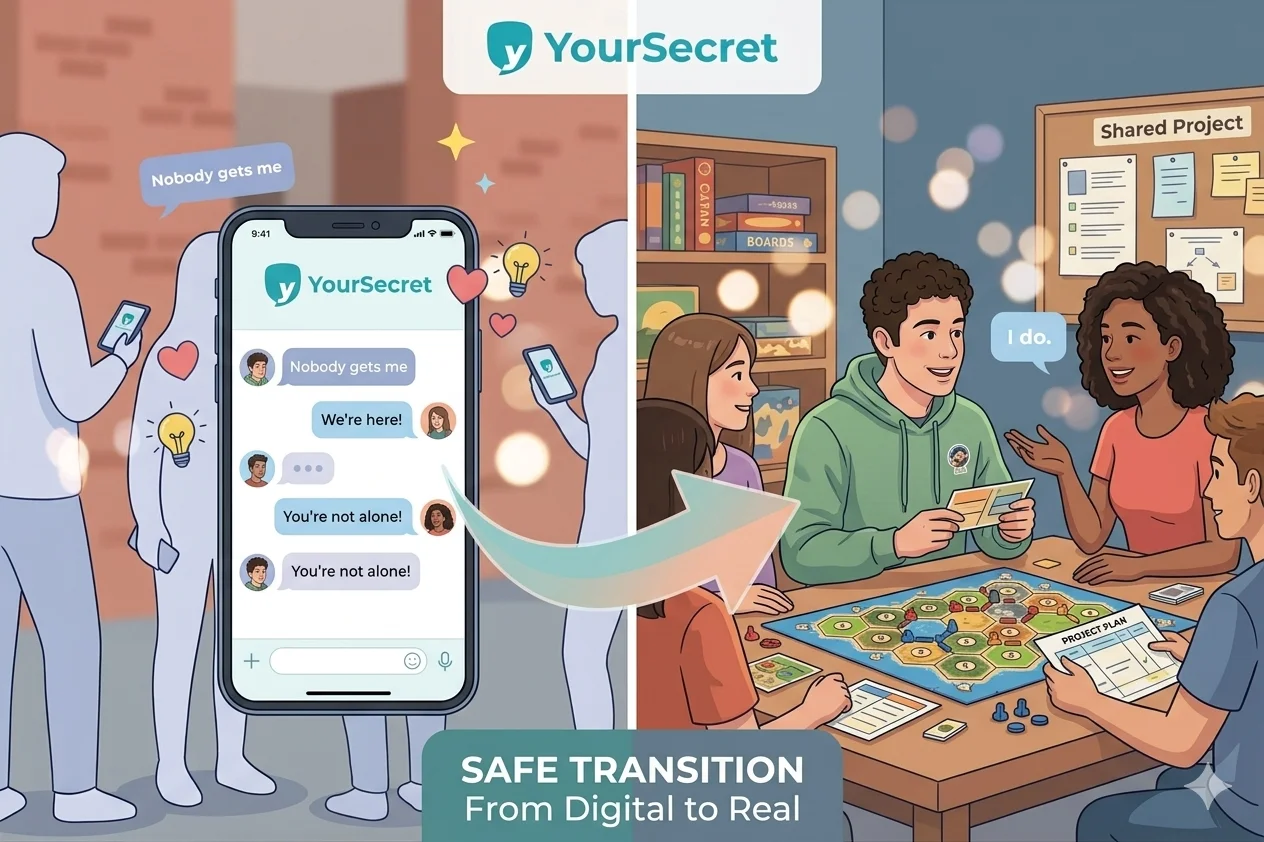
You don’t need to jump into a live conversation right away. Message a classmate about a lecture. Join a student chat. This isn’t cowardice - it’s lowering the stakes. Anonymous platforms work on the principle of peer-to-peer support: you communicate with real people without the fear of judgment. You can check out how it works to see how these safe spaces protect your identity while building confidence.
Take Your First Step in a Safe Space Not quite ready to approach someone on campus yet? That’s perfectly fine. Start practicing in a place where the fear of judgment doesn’t exist.
With the YourSecret app, you can chat anonymously with fellow students, share what’s on your mind, and find your tribe based on shared interests. Think of it as the ultimate social skills simulator—minus the stress.
[Download YourSecret & Find Your People] — Your privacy is 100% protected.
2. Find Your Tribe in Niche Clubs
Mass events are the worst starting point for introverts. Look for niche clubs: board games, debates, volunteering. There is already a topic for discussion there - a shared interest. You don’t have to figure out how to start conversations with strangers; the question arises naturally. Research confirms: friendship is formed through repeated contact in low-threat conditions - this is exactly what an interest club provides.
3. Focus on Quality Over Quantity
Choose two or three people with some shared context. Follow up on details from a conversation a week ago. Ask how an exam went. Making friends with social anxiety involves small, repeated gestures of attention rather than a grand social leap. In practice, you often find that students are waiting for the other person to take the first step. Don’t wait. One short question, and the person already feels noticed. That is enough.
4. The Power of Authenticity and Self-Acceptance
The paradox is a trap: you’re so desperate to be liked that you suffocate your own personality. Trying to play the “life of the party” when you’re actually vibrating with nerves feels fake - and people smell that. Honestly? Dropping a “Look, I’m a bit awkward in crowds” is a power move. It’s real. Authenticity is a magnet for anyone tired of the “perfect” act. Honestly, forget the script. Stop burning your limited mental energy hunting for those “perfect” or ways to start a conversation that sound like they were written by a robot. Just show up, be a little messy, and let the interaction breathe. If you stumble, let it happen - real people find that much more relatable than a polished performance.
Comparison of Social Engagement Zones for Students with Anxiety
| Engagement Level | Communication Type | Psychological Objective | Comfort Level (1-10) | Recommended Platforms / Places |
|---|---|---|---|---|
| Low Stakes | Asynchronous / Digital | Exposure Therapy: Getting used to being “seen” without the pressure of immediate response. | 8-9 (Very High) | Anonymous forums (YourSecret), student Discord servers, niche Reddit communities. |
| Medium Stakes | Task-Oriented | Shared Focus: Shifting attention from “Self” to an external object or activity. | 5-6 (Moderate) | Board game clubs, coding workshops, volunteering for animal shelters. |
| High Stakes | Spontaneous Social | Tolerance of Ambiguity: Learning to handle unpredictable social cues in real-time. | 2-3 (Low) | Campus cafeterias, dorm parties, open-mic nights, mass networking events. |
| The “Golden” Zone | Niche Interest Groups | Common Ground: Establishing “Mutual Knowledge” which automatically reduces the need for small talk. | 7 (High) | Language exchange groups, debating societies, specialized hobby circles. |
Mastering Small Talk Without the Awkwardness
There is a simple technique: question → follow-up question based on the answer. If a person says they are tired after a seminar, ask about that seminar. These strategies on how to start a conversation work not because you are witty, but because you are attentive.
Another technique is compliment + question. “Cool book, have you read his other works?” This immediately creates a point of contact. The goal is not to make an impression, but to leave a neutral trace. Next time will be a little easier - and that is already progress. How do you start a conversation with a stranger so that you don’t feel awkward? It is precisely through situational context: what is happening right now always serves as a ready-made excuse. When it comes to how to strike up a conversation with a stranger effectively, just look at your immediate surroundings.
Cognitive Tools: Overcoming the “Spotlight Effect”
A practical tool is reattribution: when the thought arises “everyone noticed I said something stupid,” replace it with the question “Are you sure? How can I prove that?” As a rule, there is no evidence.
Another tool is identity mapping: write down who you are outside of your anxiety - what interests you, what you understand well. This helps build a conversation from a position of interest rather than fear. Modern apps use similar logic: psychometric profiling and matching algorithms find people with similar thinking patterns, removing randomness from making acquaintances. If you’re ready to test it out, you can download the app and start practicing in a low-pressure environment.
When to Seek Professional Support for College Stress
If anxiety prevents you from attending classes, if avoidance has become a habitual pattern, and if isolation lasts for several weeks - this is a signal. According to the National Institute of Mental Health , anxiety disorders are treatable in most cases, but less than 40% of people seek help.
Social anxiety at university is not a reason to be ashamed. Most universities offer free consultations. If a face-to-face appointment scares you, start with chat support - this is a standard service.
Farnora Limited builds safe anonymous spaces for students and young professionals. The flagship project, YourSecret, uses intelligent matching and three levels of support - from peer-to-peer communication to professional psychologists - so that everyone can open up without fear. Privacy first: we never sell data.
Fun Fact: On average, it takes about 50 hours of shared time to form a real friendship. The person sitting next to you in class all semester is already halfway to becoming a friend - you just haven’t started the conversation yet.
Celebrate the Small Wins
Struggling to make friends in college is not a diagnosis. It is a stage that most students go through; it’s just that not everyone talks about it out loud.
Start small. One “hello.” One message. One club. Small, repeated steps create connections - not grand leaps. Move at your own pace and celebrate every moment when contact actually happens. This is what it means to start a conversation with the life you want. If you want to practice in a safe environment, YourSecret is waiting for you.
FAQ
How do I start a conversation with a stranger if I am very nervous?
Use a situational excuse: ask about an assignment or the schedule. This takes the pressure off - the question is logical. Learning how to strike up a conversation with a stranger is easiest through the context of the moment rather than a canned phrase.
Is it normal not to have friends in the first semester?
Absolutely normal. Most acquaintances are formed in the second half of the year when the rhythm of life has stabilized and regular points of intersection with the same people have appeared. If you are struggling to make friends in college right now, it’s not a signal of failure, but simply a matter of time and the right context.
What if I don’t understand how to make friends even after trying?
Change the format: if face-to-face communication isn’t working, try digital. Anonymous platforms provide practice without risk. Gradually, the skill transfers to offline settings.
How does social anxiety differ from regular shyness?
Shyness is a personality trait. Social anxiety college is a pattern of avoidance that interferes with studies and daily life. If anxiety prevents you from eating in the cafeteria or going to classes, it is a reason to talk to a specialist.
How to make friends in college if you are shy - without pretending?
Look for people who share your interests, not the “right crowd.” In niche clubs, a mask isn’t necessary: the conversation arises by itself because you already have a common topic. This is the best advice on how to make friends in college if you are shy.
Do anonymous apps help with social anxiety?
Yes - as a training environment. They reduce the risk of judgment and provide real communication practice. Ephemeral messaging solves the fear of permanence: messages disappear, but the skill remains.