How to Talk to Strangers: Small Talk Tips for the Campus
Your first day at university. Hundreds of unfamiliar faces are all around you. You sit down for a lecture next to someone who could become your best friend, but… you stay silent. Does that sound familiar? The ability to master how to talk to someone you don’t know is one of the most underrated skills of student life. It is not a talent or an innate trait, but specifically a skill. It can be developed-much like building muscle or learning how to cook pasta without it sticking to the bottom of the pot.
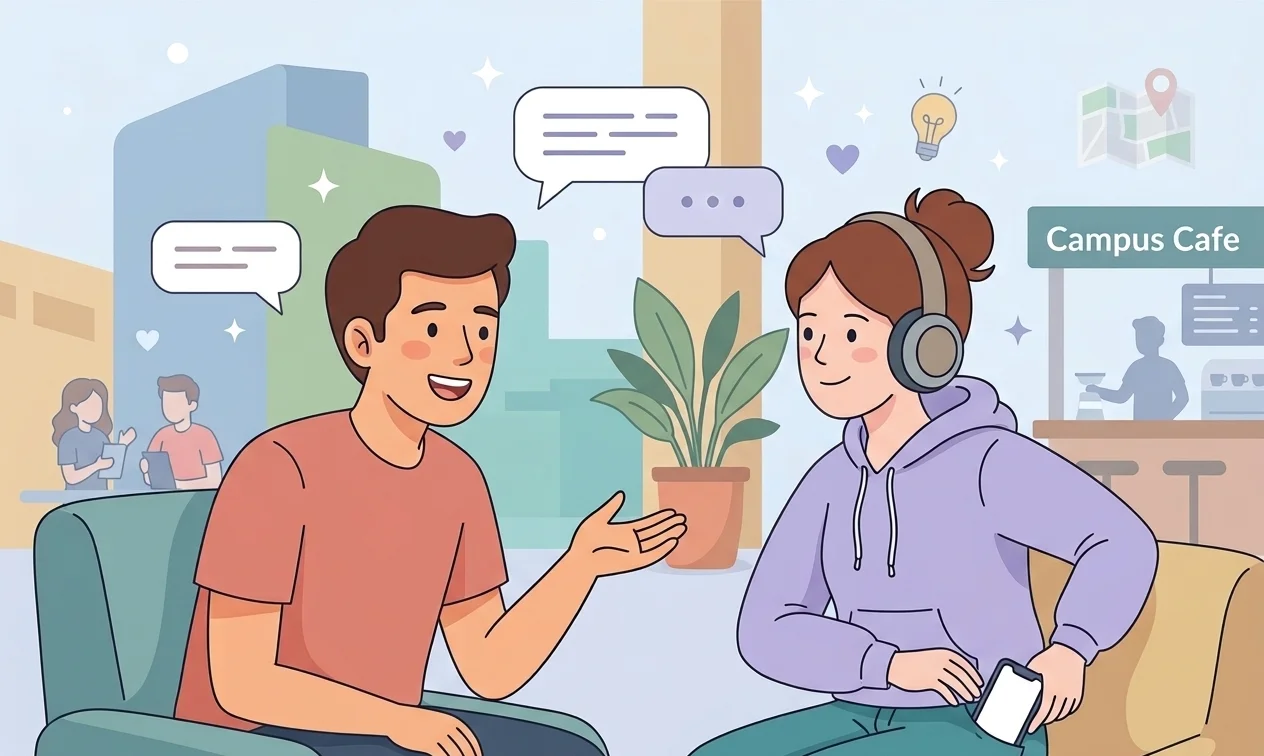
Small talk is intimidating because it feels artificial. “Why talk about the weather?” you might think. But it is not about the topic. It is about giving another person a signal: “I am open, I am interested.” That is exactly what works. From there, it is all about practice and more practice.
YourSecret is a platform for anonymous communication, created by Farnora Limited specifically for students and young professionals in the US. Our mission is to give people a safe space to speak honestly - without fear of judgment, without a digital trail that follows you afterward. Three levels of support - an anonymous chat with fellow users, an AI consultant, and access to professional psychologists - help you find the right format at the right moment.
What is Considered Small Talk and Why It Is Necessary
A common question is what is considered small talk exactly. It is a light, no-strings-attached conversation. It is not a formal chat with an ambassador, nor a 3 a.m. confession to a friend. It is simply a few phrases that relieve social tension and open the door to something more. Small talk is the foundation of any acquaintance, whether it is a new classmate, a roommate, or a random person in the elevator.
On campus, its role is particularly significant. You enter an environment where everyone is roughly equally lost-especially at the beginning. This provides a unique opportunity: it is appropriate here to start a conversation with almost anyone, and it won’t look strange.
Research shows that even a short interaction with a stranger improves mood and the feeling of being connected to the world. But in reality, we often face something else: people fear rejection or looking stupid, so they stay silent. Yet, it is the first step that breaks this vicious cycle.
How to Start Conversations: Specific Techniques
The good news is: you don’t have to be witty. You just have to be present.
Campus Social Navigation: Quick Reference Guide
| Situation | The “Safety” Move (Low Risk) | The “Pro” Move (High Reward) | What to Avoid (The “Dead End”) |
|---|---|---|---|
| Waiting for a Professor | “Do you know if the slides will be uploaded online later?” | “I honestly struggled with the last reading. Did any of it make sense to you?” | Staying on your phone with noise-canceling headphones on. |
| In the Dining Hall / Cafe | “Is this seat taken? Also, have you tried the daily special yet?” | “I see you’re having the [dish]. I’ve been debating getting it-is it actually good?” | Asking personal questions about their diet or body. |
| At the Campus Gym | “Excuse me, do you know how many sets you have left on this?” | “I love your [brand/team] gym shirt! Are you a fan of them or just like the design?” | Interrupting someone mid-set or while they have high-intensity music playing. |
| Club/Society Meeting | “Is this your first time at this club, or have you been here before?” | “What made you decide to join this specific group over the others on campus?” | Complaining about how bored you are or how “weird” the activity is. |
| After a Group Project | “Good job today. Are you heading toward the library or the dorms?” | “You made a great point about [topic]. Where did you learn about that?” | Leaving immediately without saying a single word to the team. |
Open-Ended Questions Instead of Closed Ones
“Do you study here?” is a dead end. “How to start conversations that actually last? Use open-ended questions like ‘What do you think of the statistics course?’” Open-ended questions don’t allow for a simple “yes” or “no”-they invite the person to express themselves. This takes the pressure off you and shifts the focus to the listener.
Here are some effective conversation starters for college students:
- “Have you found a decent place to work in the library yet?”
- “How do you like the XY seminar-is it really as hard as they said?”
- “Are you a freshman or did you transfer?”
Notice: all of them are tied to the context. This is important. The person understands why you spoke up right now and specifically to them-because you share a common situation.
How to Invite Conversation Without Asking a Question
A simple formula: notice something out loud. “The coffee machine is broken again-third time this week,” or “Interesting book, I saw it on the recommended list.” This is not a question, not an assertion-it is an invitation. The person can pick it up or politely smile and leave. Neither outcome is a catastrophe.
Body Language Speaks Before Words
Eye contact, a light smile, an open posture-this is what really works before the first word is said. If you are sitting with headphones on, staring at your phone, even the most brilliant phrase won’t help. Your body should broadcast: “I’m here, I’m okay, it’s fine to approach me.”
How to Start a Conversation with Someone You Like Without Awkward Pauses
One of the main problems is the silence after the first phrase. It feels like you need to urgently say something, otherwise everything will collapse. In reality, it doesn’t. A pause is normal. You don’t need to fill it with random words.
My advice: don’t waste energy looking for the “perfect topic”-follow what the person is saying. Active listening works wonders. A nod, a short “yeah, I get it,” a clarifying question-and the conversation flows on its own. This is the secret to starting a dialogue with someone you like effectively.
Another trap is the desire to impress. People sense when someone is speaking “for the audience.” The most reliable way to be liked is to be sincerely interested in the person. It isn’t hard; it’s just simple.
How to Start a Text Conversation: Small Talk in Print
Knowing how to start a text conversation works a bit differently. There is no intonation, no facial expressions-only words. Therefore:
- Write shorter than you think is necessary.
- The first message should have a specific reason, not a general “hi.”
- A question at the end of the message almost always helps to get a reply.
“Hey, I think we were in the same class-do you remember what the assignment was for next week?” is a working scheme. Simple, specific, and there is a reason to write.
How to Approach a Stranger and Not Fail
Learning how to approach a stranger is a whole different level. But this is exactly how chance encounters turn into real ones. A few rules:
- Read the context. A person with headphones buried in a laptop 10 minutes before a deadline is not the best moment. A person in line for food or during a break is a different story.
- Don’t apologize for speaking. “Sorry to bother you” is a weak start; it immediately lowers your status in the conversation. It is better to just say something-without introductions.
- Leave an exit. “Listen, I’m in a rush, but I wanted to ask…"-this lets the listener know the conversation won’t last forever and relieves their tension as well.
How to Find Friends at University if You are an Introvert
Being an introvert doesn’t mean you don’t need people. It means you need a different format. Big parties aren’t necessarily the best way. Sometimes it’s more effective to try:
- Interest clubs: There is already a common topic, making small talk happen naturally.
- Study groups: A common task brings people together quickly.
- Online acquaintances through student chats-it’s easier to move them offline later.
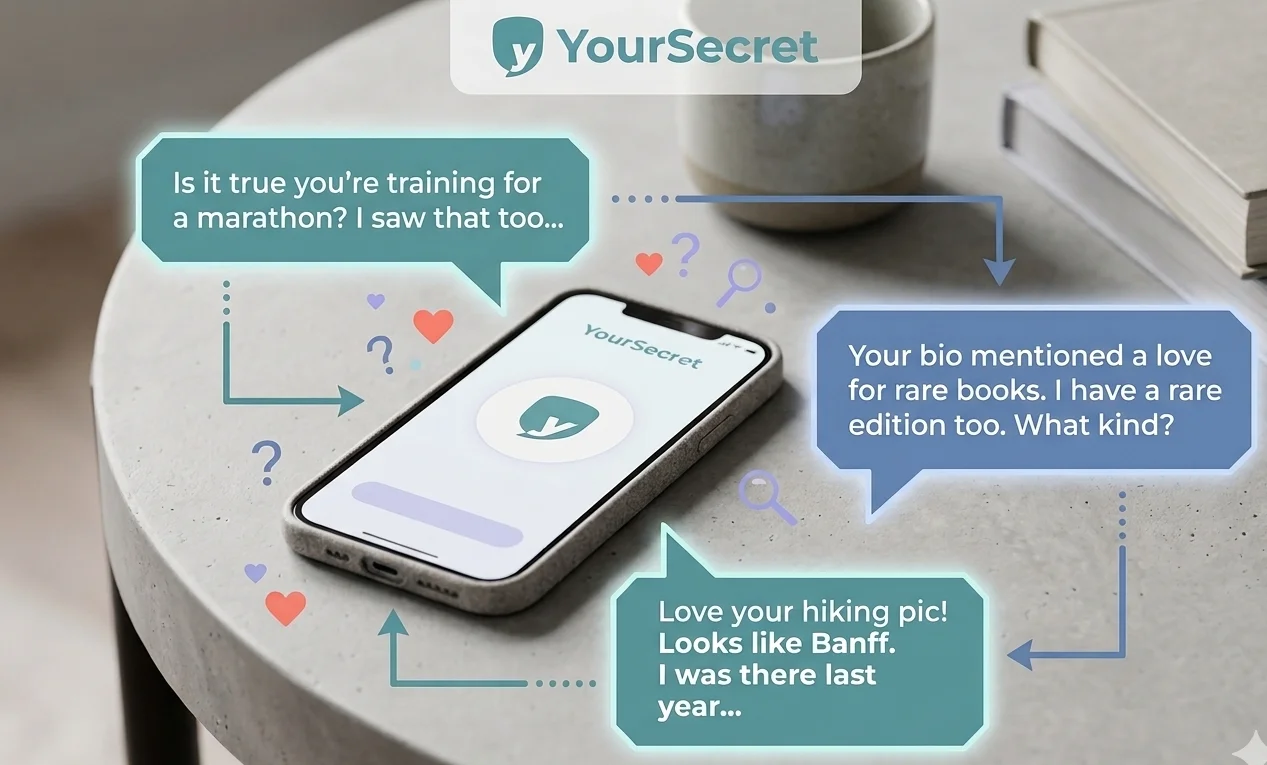
And if it’s really difficult, there are spaces where you can practice communication skills without risk. AAnonymous platforms like YourSecret allow you to know how to make small talk with strangers without fear of judgment. If you are wondering how our app works, a matching algorithm selects interlocutors based on interests and psychotypes, and ephemeral messaging means the conversation disappears-only the experience remains.
🎲 Fun Fact: Research from the University of Chicago has shown that people systematically underestimate how willing strangers are to talk to them. Psychologists call this the “lesser-than-expected interest” or “the illusion of the cold shoulder”-we fear rejection that almost never happens.
FAQ
What is small talk and why is it important for students?
Small talk is a short, casual conversation without deep topics. For students, it is especially important because a campus is an environment of constant new acquaintances. It is exactly these small talk tips that open doors to real friendships and professional connections.
How do I make friends at university if I am very shy?
Start with something tied to the situation: a shared line, the same class, the same course. A situational question sounds natural and doesn’t require much courage. This is the core of how I make friends at university. You don’t need to invent a reason-it’s already there.
How to start a convo with a boy or a stranger in a messenger?
The first message should be short and have a specific reason: a question about a class, a shared interest, or mentioning a mutual acquaintance. Knowing how to start a convo with a boy involves avoiding a generic “hi” without context, which creates awkwardness.
How to start conversation with a guy in person?
Use your surroundings. If you are both waiting for a professor, comment on the upcoming exam. This is the simplest way of starting a conversation with a guy without it feeling forced.
How to make friends in college as an introvert?
Look for formats with a shared theme: clubs, study groups, or student chats. This removes the need to “invent a conversation”-the topic is already there. This is a primary strategy for how to make friends in college as an introvert. Anonymous platforms also help: you can practice communication without social risk.
How to find friends at university effectively?
The best way to find friends at university is to be consistent. Join organizations or show up to the same lounge area regularly. Familiarity breeds comfort.
How to stop being afraid of approaching strangers?
Remind yourself: most people react kindly to being spoken to - this is confirmed by research in social psychology. The fear of rejection is greatly exaggerated. Start with small steps: prepare a few simple conversation starters with strangers, such as one question in a line or one comment during a seminar. Over time, initiating these interactions will become a natural habit.
The ability to talk to people is not about charisma or extroversion. It is about the willingness to take the first step. Small talk is just a tool. It can be used in different ways: in the classroom, in line for coffee, in a text message, or in an anonymous chat where identity mapping and a matching algorithm do part of the work for you. The main thing is to start-you can download app today to take your first step safely.